
Unlocking the secret lives of marine animals using shells and bones
A new research program to develop a new tool for marine biologists
Radiogenic isotopes are prized for tracking the movement and provenance of organisms and biological materials in terrestrial systems, but marine systems are missing out on this tantalising tool. Thanks to funding from the Australian Research Council, over the next 4 years we will be developing a research program on radiogenic isotopes for marine systems.
Our two latest papers on neodymium isotopes are a prologue to this program, which have been led by Zoe and PhD student, Arieli.
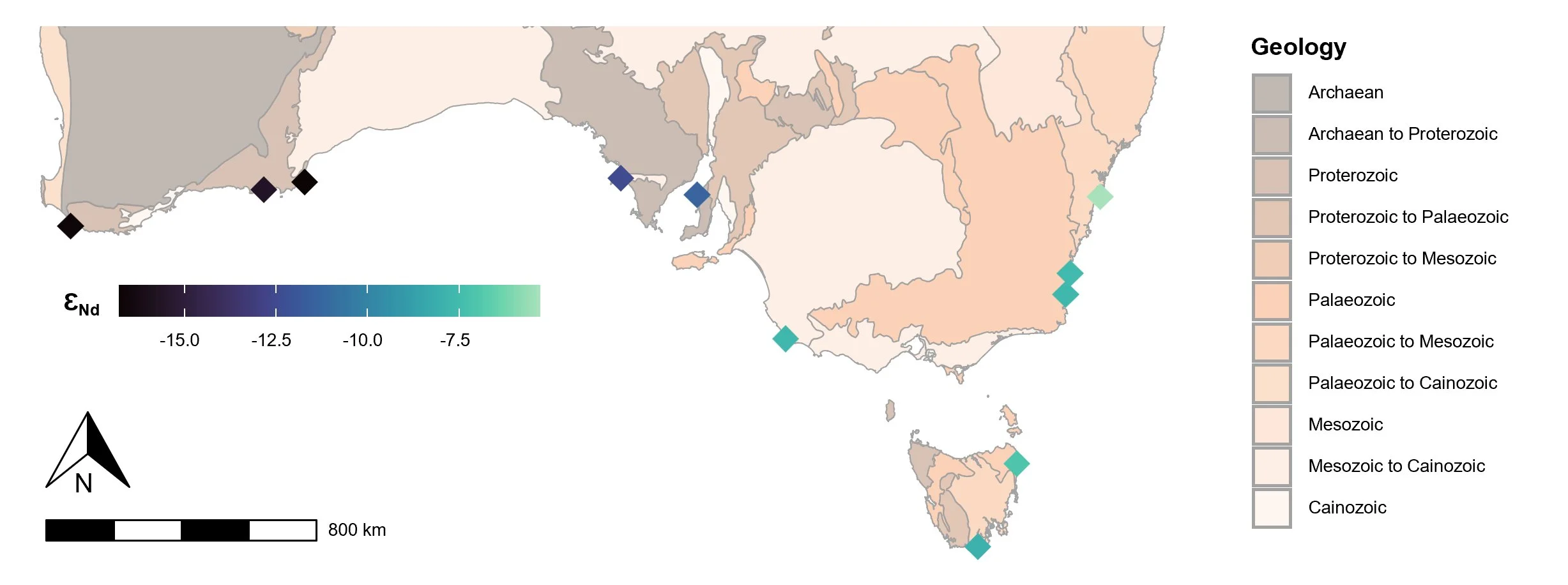
Key figure from Zoe’s paper “The geological imprint of neodymium isotopes in marine gastropods.” It shows the mean values of neodymium isotope ratios in abalone shells collected throughout southern Australia, and how those values reflect local geology and rock age, with older rocks in the wester and younger rocks in the east.
A window into another world: the chemical stories of gastric ossicles
Building on from our ideas about leveraging the wealth of chemical data inside the hard accretionary tissues of aquatic life (see below), in 2025, Maris Lab applied the concept of chemical sclerochronology to decapod crustaceans. Specifically, using structures called gastric ossicles. We envisage that chemical profiles in gastric ossicle could revolutionise our understanding of crustaceans in a similar vein to how otoliths have revolutionised our understand of fish ecology and movement.
This research has been spearheaded by honours student, Kaitlyn Rowney, who submitted her first class thesis at the end of 2025, as well as PhD student, Arieli Tristao Rezio. Watch this space for publications.
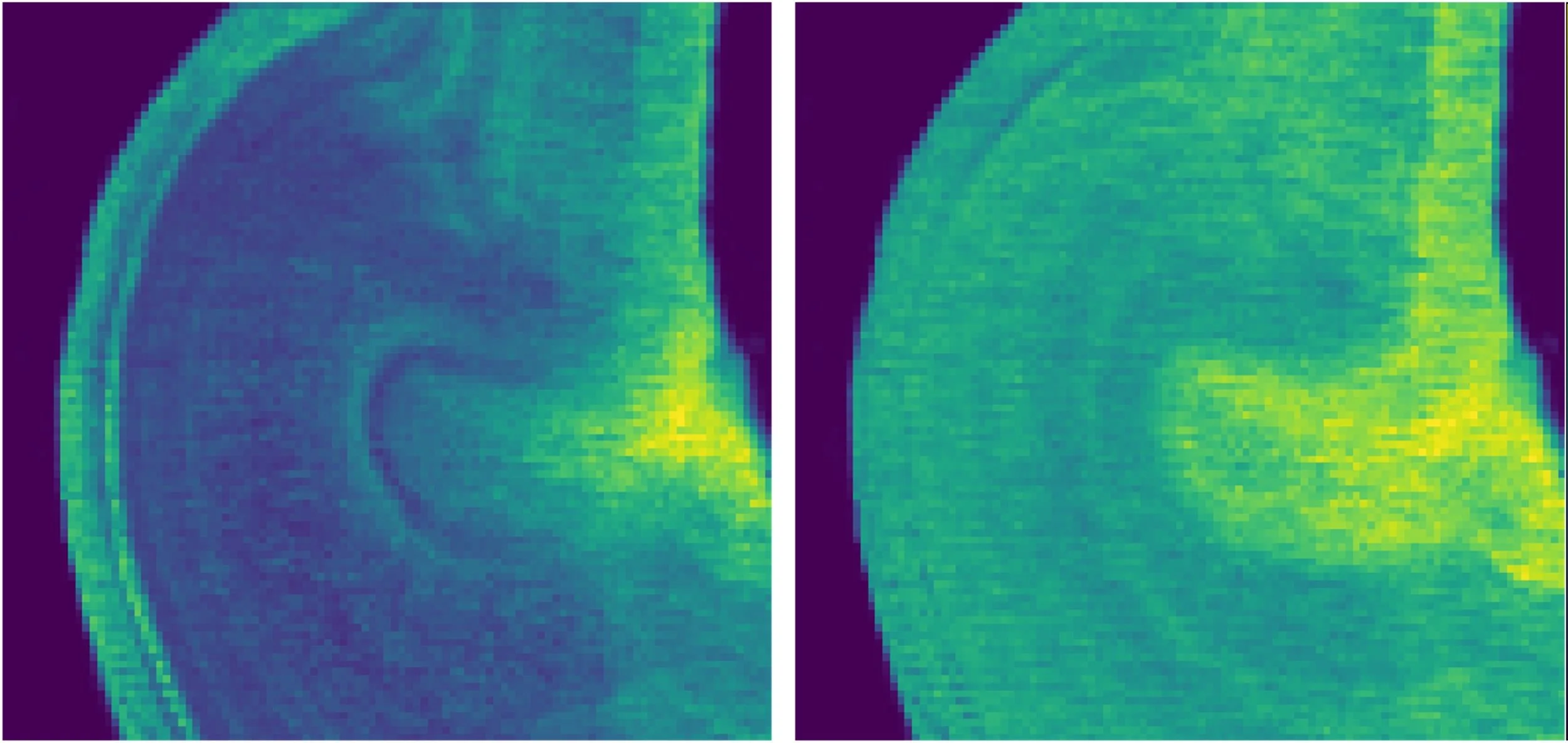
Chemical maps of gastric ossicles dissected from crabs. Left: shows a map of phosphorus concentrations; right: shows a map of strontium concentrations. These chemical maps tell a story about the ecology and movement of crabs. Maps produced by Kaitlyn Rowney©.

Capitalizing on the wealth of chemical data in accretionary structures
Aquatic organisms are natural data loggers and record chemical variations within hardened accretionary structures like shells and teeth. Chemical sclerochronology is the study of these chemical variations through time and how they are used to understand environmental change and the physiology and ecology of species.
In this study, led by Zoe, and including Maris Lab members, Arieli, Louise, and Jasper, we compiled a database of chemical sclerochronology studies spanning nine living phyla and 19 classes. We then examined research trends and knowledge gaps across these taxa and showcase their exciting potential to collect critical data and address pressing environmental and ecological challenges.

Using isotopic fingerprints to track the provenance of a commercially valuable species
This study, led by Honours student, Elise Boultby, shows how geochemical markers or fingerprints in gastropod shells can be used to track the provenance of origins of valuable commercial species. Elise tested her research out on wild caught and farmed Australian abalone.
Reading the Biomineralized Book of Life
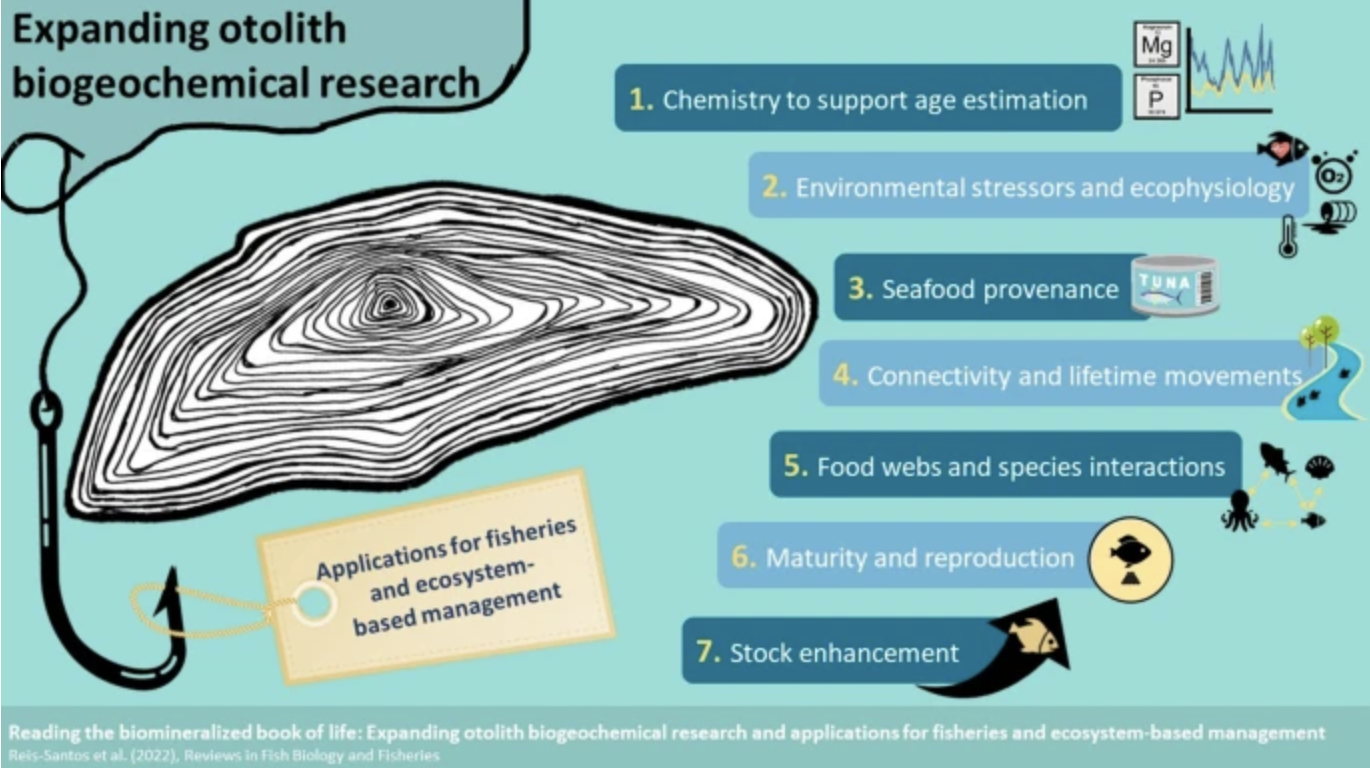
In this large collaborative paper led by Patrick Reis Santos, the authorship team summarise recent advancements and challenges that lie ahead for otolith geochemistry and it use in fisheries and ecosystem-based management.
Read the paper here
Introducing the “universal marker” concept and how it could be used to track a greater spectrum of marine life
Read our concept paper here

Reconstructing the Environmental Histories of Cephalopods
Read our paper here led by Dr Jasmin Martino

Select Publications
2026: Can neodymium be extracted from a wide range of marine species and tissue types?
2026: The geological imprint of neodymium isotopes in marine gastropods
2025: Capitalizing on the wealth of chemical data in the accretionary structures of aquatic taxa
2022: Expanding otolith biogeochemical research and applications for fisheries management
2022:Harnessing universal chemical markers to trace the provenance of marine animals
2022:Systematic evaluation of oxygen isotopes in cephalopod statoliths as thermal proxies
2021:Statolith chemistry: a new tool to understand the ecology and provenance of octopus
2020:Experimental support towards a metabolic proxy in fish using otolith carbon isotopes